
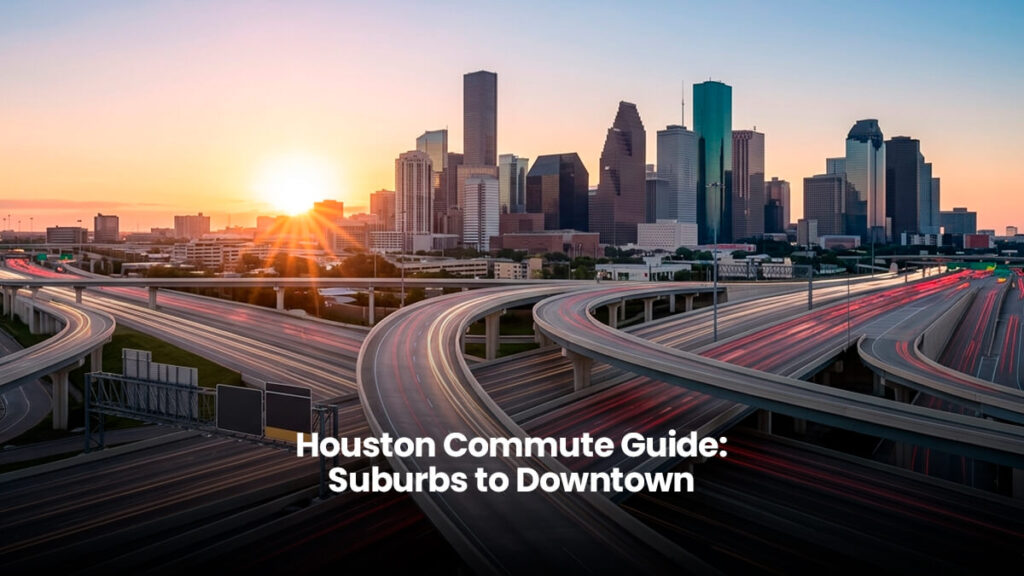
If there is one thing we talk about in Houston just as much as our award-winning culinary scene and booming economy, it is our traffic. Houston is a beautiful, sprawling metroplex, and as a dedicated local Realtor, the number one question my clients ask when touring homes is: “Aida, what is the commute actually going to look like from here to Downtown?”
It is a crucial question. Your daily drive impacts your quality of life, your family time, and your peace of mind. Choosing the right suburb isn’t just about finding the perfect floor plan; it’s about aligning your lifestyle with Houston’s unique highway geography.
In this comprehensive guide, I am breaking down the real, unfiltered commute profiles of Houston’s most popular suburbs to Downtown, complete with insider transit secrets and strategic real estate advice to help you navigate the market like a pro.
The Reality of the Houston Highway System
Before we look at specific suburbs, you need to understand how our city is shaped. Houston is built like a bullseye, defined by major concentric loops:
Loop 610: Encircles the immediate inner loop (Downtown, Midtown, the Medical Center).
Beltway 8 (Sam Houston Tollway): The middle ring connecting the outer edges of the city proper.
Grand Parkway (State Highway 99): The massive outer loop that connects almost all of our major master-planned suburban communities.
Spoking out from these loops are the major freeways that carry suburban commuters into the heart of the city every single day. Let’s look at how the top suburbs stack up.
1. The West Side Corridor: Katy & Cypress
Katy, Texas
Main Route: Interstate 10 (The Katy Freeway)
Average Commute Time: 45 to 75 minutes during peak rush hours (7:00 AM – 9:00 AM / 4:30 PM – 6:30 PM).
The Insider Scoop: The Katy Freeway is famously one of the widest freeways in the world. While that sounds intimidating, it actually gives you options. If you are driving solo, you can utilize the managed Managed Lanes (toll lanes) in the center to bypass heavy congestion.
Aida’s Transit Secret: Don’t want to drive? The Houston METRO Park & Ride system from the Katy area (like the Kingsland or Addicks locations) is an absolute game-changer. You hop on a comfortable, Wi-Fi-enabled coach bus, ride the dedicated HOV lane, and get dropped off right in Downtown Houston without ever touching a steering wheel.
Cypress, Texas
Main Route: US-290 East to I-610 or I-10
Average Commute Time: 50 to 80 minutes.
The Insider Scoop: Thanks to massive expansion projects over the last few years, US-290 flows significantly better than it used to. However, the bottleneck usually happens right where 290 hits Loop 610.
Aida’s Transit Secret: If you live closer to the southern edge of Cypress, you can easily cut across to I-10 or use the Barker Cypress METRO Park & Ride to streamline your morning.
2. The Northern Giants: The Woodlands & Spring
The Woodlands, Texas
Main Route: Interstate 45 South
Average Commute Time: 50 to 90 minutes.
The Insider Scoop: The Woodlands is arguably one of the most prestigious master-planned communities in the country, but it sits roughly 30 miles north of Downtown. I-45 South during morning rush hour requires patience.
Aida’s Transit Secret: To preserve your sanity, you absolutely must get a toll tag. Taking the Hardy Toll Road instead of I-45 can save you a solid 15 to 20 minutes when the main interstate gridlocks. Even better, The Woodlands runs its own highly efficient, luxury commuter bus service directly into Downtown and the Texas Medical Center.
3. The Southwest & South: Sugar Land & Pearland
Sugar Land, Texas
Main Route: US-59/I-69 North
Average Commute Time: 40 to 65 minutes.
The Insider Scoop: Sugar Land is highly sought-after for its incredible schools and diverse communities. The commute along US-59 is generally more predictable than I-45 or I-10, though the intersection near highway 6 and the West Loop can slow to a crawl.
Aida’s Transit Secret: Look into the Fort Bend County Public Transportation commuter buses, or utilize the Fort Bend Parkway Toll Road if you are living on the eastern side of Sugar Land near Missouri City.
Pearland, Texas
Main Route: TX-288 North
Average Commute Time: 30 to 50 minutes.
The Insider Scoop: Geographically, Pearland is much closer to Downtown and the Texas Medical Center than the outer-loop suburbs like Katy or The Woodlands.
Aida’s Transit Secret: The relatively recent completion of the TX-288 Express Toll Lanes means you can practically cruise into Downtown even during peak hours if you are willing to pay the toll fee. This makes Pearland one of the most efficient suburban commutes in the entire region.
Aida’s Suburban Commute Survival Toolkit
No matter which beautiful Houston suburb you choose to call home, surviving and thriving during your commute comes down to three non-negotiable tools:
Get an EZ TAG immediately: Do not wait until you move into your new home. The Harris County Toll Road Authority (HCTRA) manages our extensive toll network. Having an active toll tag saves you money and allows you to seamlessly jump onto the Hardy Toll Road, Beltway 8, or the Grand Parkway without stopping.
Bookmark Real-Time Traffic Trackers: Before you back out of your driveway, check Houston TranStar for live incident reports, road closures, and flood warnings. Houston weather can be unpredictable, and knowing about an accident 10 minutes before you hit the road can save you an hour of delay.
Align Your Work Hours: If your employer offers flexible scheduling, working from 7:00 AM to 4:00 PM or 9:30 AM to 6:30 PM can completely transform your commute, cutting your time on the road in half.
Real Estate Strategy: Balancing Drive Time vs. Home Value
When I sit down with my home buyers, we look at the big picture. Suburbs that are geographically closer to Downtown or offer faster toll routes (like Pearland or inner Sugar Land) often command a premium for their location. On the flip side, you might get more square footage or a larger lot for your money farther out in areas like Fulshear (past Katy) or Magnolia (past The Woodlands), but you will pay for it in time spent on the highway.
My job is to help you find that perfect sweet spot where your monthly housing budget and your tolerance for driving intersect perfectly.
Frequently Asked Questions (Houston Commute FAQ)
What is the best suburb of Houston for commuting to Downtown?
If your primary goal is the shortest drive time from a true suburban environment, Pearland and Sugar Land are consistently top choices due to their geographical proximity and direct highway access (TX-288 and US-59).
How much does it cost to use Houston toll roads daily?
Depending on how far out you live and which express lanes you use, a round-trip daily commute using toll roads can range anywhere from $5 to $15 per day. Most commuters find the time saved is well worth the investment.
Is public transit a viable option from the Houston suburbs?
Yes, absolutely! The METRO Park & Ride system is incredibly popular and efficient. It features dedicated transit centers throughout suburbs like Katy, Cypress, Spring, and Clear Lake, offering direct, stress-free bus routes into Downtown via the HOV lanes.
What time does rush hour start in Houston?
Morning rush hour generally starts winding up around 6:30 AM, peaking heavily between 7:15 AM and 8:30 AM. Evening rush hour begins as early as 4:00 PM and usually clears up by 6:30 PM.
How does flooding affect the Houston commute?
Because Houston is relatively flat, heavy downpours can cause rapid, localized street flooding. Major freeways are designed with sophisticated drainage, but key underpasses can accumulate water. Always check your traffic apps and Houston TranStar during heavy rain events before commuting.
Ready to Find Your Perfect Houston Home?
Navigating the Houston real estate market is all about making informed choices. You deserve a home that you love and a daily routine that doesn’t leave you feeling drained before your workday even begins.
Whether you are looking for a master-planned community with resort-style amenities in The Woodlands, an expansive property in Katy, or a quick commute from Pearland, I am here to guide you every step of the way. Let’s sit down, discuss your daily routine, and map out your next move together.
Contact me today to start your Houston home-buying journey!
Aida Villalobos | Real Estate Broker
📞(346) 955-1049 / @realtor.aidavillalobos