
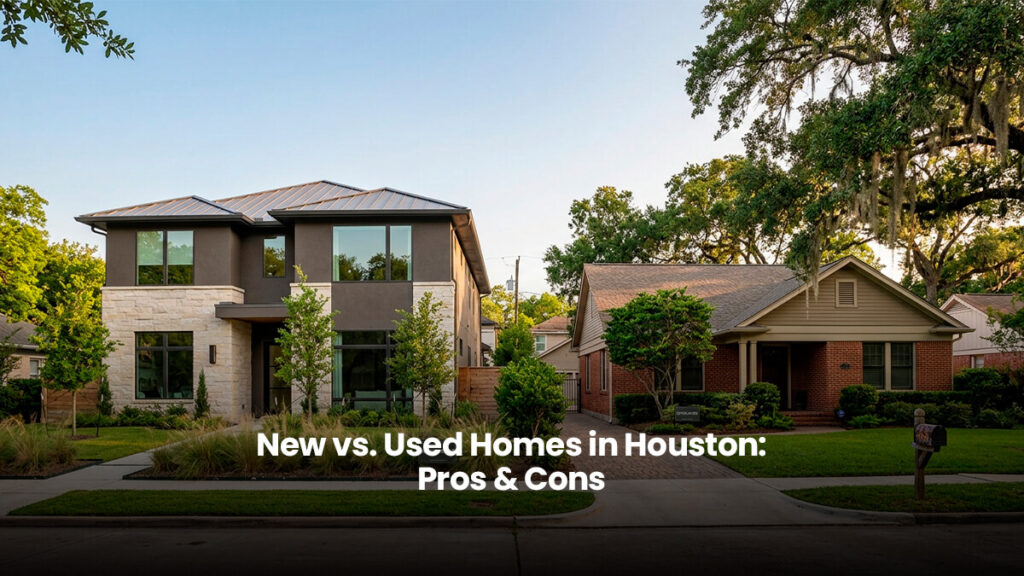
In Houston, the choice between a new construction home and a resale (used) home comes down to a trade-off between upfront financing incentives and long-term carrying costs. While new builds in master-planned suburbs often feature attractive builder rate buydowns and high energy efficiency, they frequently carry Municipal Utility District (MUD) taxes that can increase monthly expenses. Conversely, established resale homes in areas like The Heights or inner-loop Houston offer mature lots, prime locations, and predictable tax structures, but may require budgeting for deferred maintenance and older systems.
New vs. Used Homes in Houston: Pros & Cons
Hello, Houston! If you have been scrolling through listings across Greater Houston, you have likely found yourself caught in one of the most common real estate dilemmas: Should I buy a brand-new construction home or a well-established resale property?
As a dedicated Realtor working right here in Houston, Texas, I sit down with buyers facing this exact crossroads every single week. The Houston real estate landscape is wonderfully diverse—stretching from the bustling inner-loop neighborhoods filled with historic charm to rapidly expanding master-planned communities in Katy, Cypress, Fulshear, and The Woodlands.
However, looking at a sticker price online only tells half the story. To make a smart financial decision, you have to look past the shiny model home staging and understand the real, day-to-day carrying costs of living in our unique Texas market. Let’s dive deep into the pros, cons, hidden expenses, and local realities of new versus used homes in Houston.
The Houston Real Estate Landscape: What the Numbers Tell Us
The Houston housing market operates on a scale unlike almost anywhere else in the country. According to market data from the Houston Association of Realtors (HAR), inventory levels have given buyers more breathing room and negotiating power than we saw during the extreme market frenzies of previous years.
Traditionally, buyers assumed new construction carried a massive price premium over existing homes. But current market trends analyzed by the Texas A&M Real Estate Research Center reveal that the pricing gap has narrowed significantly. Today, homebuilders are competing aggressively for buyers by offering powerful financial incentives—such as permanent interest-rate buydowns—while resale sellers are frequently offering buyer concessions to close deals in a balanced inventory environment.
To determine which option fits your lifestyle and financial goals, let’s examine the specific advantages and drawbacks of each path.
New Construction Homes in Houston: Pros & Cons
Buying a brand-new home that has never been lived in is an exciting milestone. You get to select finishes, enjoy untouched surfaces, and move into a community designed from the ground up for modern living.
The Pros of New Construction
Modern Energy Efficiency: Texas summers are notoriously brutal on utility bills. New construction homes built to current Texas energy codes feature advanced insulation, double-paned low-E windows, and high-SEER HVAC systems. This often saves homeowners $150 to $300 a month on electricity compared to older homes.
Builder Warranties: Most new builds come with structural warranties (such as 1-year workmanship, 2-year systems, and 10-year structural coverage), offering incredible peace of mind during your first years of ownership.
Financing Incentives and Rate Buydowns: In response to fluctuating interest rates, many Houston-area builders work with preferred lenders to offer rate buydowns that can significantly lower your monthly mortgage payment.
Contemporary Floor Plans: Open-concept layouts, high ceilings, built-in smart home technology, and functional home-office spaces cater perfectly to modern remote work and family lifestyles.
The Cons of New Construction
Municipal Utility District (MUD) Taxes: Many of Houston’s premier master-planned suburbs are located within MUDs. These districts issue bonds to fund water, sewer, and drainage infrastructure, adding an extra 0.50% to 1.50% to your annual property tax rate.
The Year-Two Property Tax Jump: Texas appraisal districts assess new construction as of January 1st. If your home is completed after that date, your first year’s tax bill is often based solely on the land value. In year two, once the full improvement is added to the tax rolls, homeowners can experience a sudden and unexpected tax spike.
Suburban Location & Commute: Most massive new-construction developments are pushed further out toward the outer loops and suburban corridors, which can translate into longer daily commutes if your office is in downtown Houston, the Texas Medical Center, or the Energy Corridor.
Immature Landscaping: Newly graded lots lack mature trees, shade, and established landscaping, meaning you will spend time and money planting greenery and building out backyard privacy.
Used (Resale) Homes in Houston: Pros & Cons
Resale homes represent the heartbeat of Houston’s established neighborhoods—from the historic bungalows of The Heights and Montrose to the established, tree-lined streets of Kingwood, Sugar Land, and Meyerland.
The Pros of Resale Homes
Established Prime Locations: Resale homes are often located closer to employment hubs, established dining districts, cultural centers, and top-tier school clusters, cutting down significantly on daily transit times.
Mature Trees and Neighborhood Character: You simply cannot manufacture 50-year-old oak trees overnight. Resale neighborhoods offer established character, unique architectural details, wider lots, and a settled community feel.
Fewer Hidden Tax Surprises: Many established homes sit within city limits or older taxing districts without heavy MUD bond assessments, keeping property tax calculations more predictable over time.
Immediate Negotiation Leverage: With robust resale inventory circulating across the Houston market, buyers frequently have room to negotiate purchase prices, seller concessions, or repair credits directly with the homeowner.
The Cons of Resale Homes
Deferred Maintenance Risks: Buying a pre-owned home means inheriting the previous owner’s maintenance history. Older roofs, aging plumbing, and aging HVAC units may require unexpected capital expenditures shortly after closing.
Outdated Layouts: Older homes may feature choppy floor plans, smaller kitchen footprints, single-sink bathrooms, or less electrical capacity to handle modern tech and EV chargers.
Higher Near-Term Renovation Costs: If you want to modernize finishes, knock down walls, or update bathrooms, you will need to roll those renovation costs into cash reserves or specialized renovation loans.
Comparison Table: New vs. Used Homes at a Glance
| Feature | New Construction Homes | Resale (Used) Homes |
| Average Initial Price | Comparable base pricing, but subject to lot premiums and design upgrades. | Often competitive on sticker price with room for negotiation. |
| Property Taxes & MUDs | Frequently higher due to MUD/PID bond taxes in master-planned suburbs. | Generally more stable tax rates in established city districts. |
| Energy Efficiency | Exceptional (modern insulation, high-SEER HVAC, low-E glass). | Varies; older homes may require insulation or window upgrades. |
| Maintenance & Repairs | Low initial maintenance backed by builder structural warranties. | Higher potential for near-term repairs (roof, plumbing, HVAC). |
| Location & Commute | Typically located in growing suburban master-planned communities. | Often closer to inner-loop employment, dining, and cultural centers. |
| Financing Incentives | Aggressive builder rate buydowns and closing cost credits. | Standard market financing; sellers occasionally offer closing concessions. |
The Hidden Math: Understanding Houston Carrying Costs
When evaluating your monthly housing budget in Texas according to guidelines published by Texas REALTORS®, remember that your payment is more than just principal and interest.
In a new master-planned community, a builder’s rate buydown might save you $480 a month on your mortgage. However, if that property sits in a young MUD district with a 1.40% tax rate, the resulting tax line item can easily consume those monthly savings. Conversely, a resale home in an established neighborhood might lack a MUD tax, but you should always budget a 1% to 2% annual capital reserve fund to cover inevitable maintenance items like water heater replacements or roof repairs.
Questions & Answers (FAQs)
1. Is new construction cheaper than resale in Houston right now?
Not necessarily on sticker price. While base prices for new homes and resale homes often run neck-and-neck, the total financial comparison depends heavily on carrying costs. New builds offer attractive builder financing incentives and lower maintenance, but resale homes often avoid the steep MUD taxes found in newer suburban master-planned developments.
2. Do I need a Realtor when buying a new construction home in Houston?
Yes! Absolutely. The friendly sales agent sitting in the builder’s model home represents the builder, not you. Having an experienced local Realtor like me by your side ensures your interests are protected, contract terms are scrutinized, and maximum builder incentives or upgrades are negotiated into your purchase agreement.
3. What is a MUD tax and how does it affect my Houston home purchase?
A Municipal Utility District (MUD) is a political subdivision of the state that finances and builds water, sewer, and drainage infrastructure for new developments. MUD taxes are added on top of standard county and school district property taxes. While MUD rates typically decrease over time as development bonds are paid off, they represent an important line item in your monthly housing budget during the early years of ownership.
4. Which option has lower maintenance costs in the first few years?
New construction homes require significantly less maintenance during the first 5 to 10 years because all major systems—roofs, foundations, plumbing, and HVAC units—are brand new and protected by builder warranties. Resale homes, depending on their age, may require immediate budget allocations for upkeep and repairs.
Aida’s Step-by-Step Framework for Choosing Your Houston Home
If you are trying to decide which path is right for you, walk through this quick step-by-step evaluation:
Define Your Geographic Priority: Map out your daily commute. If you need quick access to downtown, the Energy Corridor, or the Med Center, resale homes in established pockets often win. If you want community amenities like resort-style pools, walking trails, and master-planned community events, the suburbs call.
Audit Your Total Monthly Budget: Do not just look at the loan amount. Calculate the effective property tax rate, including any MUD or PID assessments, plus projected HOA dues.
Assess Your Tolerance for Maintenance: Decide whether you prefer predictable monthly mortgage payments with zero renovation projects (new build) or investing in a customized, established property where you can gradually make upgrades over time (resale).
Partner with a Local Expert: Connect with me early in the process. I help buyers analyze address-level tax rates, review builder contract fine print, and negotiate the strongest possible terms.
Conclusion: Let’s Find Your Perfect Houston Home Together
Deciding between a sleek new construction build and a charming resale home is one of the biggest financial decisions you will make. You do not have to navigate Houston’s complex market dynamics alone.
As your trusted Houston Realtor, I am here to provide transparent guidance, rigorous data analysis, and dedicated representation from our first consultation all the way to the closing table. Reach out to me today, and let’s turn your Houston real estate goals into reality!
Aida Villalobos | Agente inmobiliaria
📞(346) 955-1049 / @realtor.aidavillalobos