
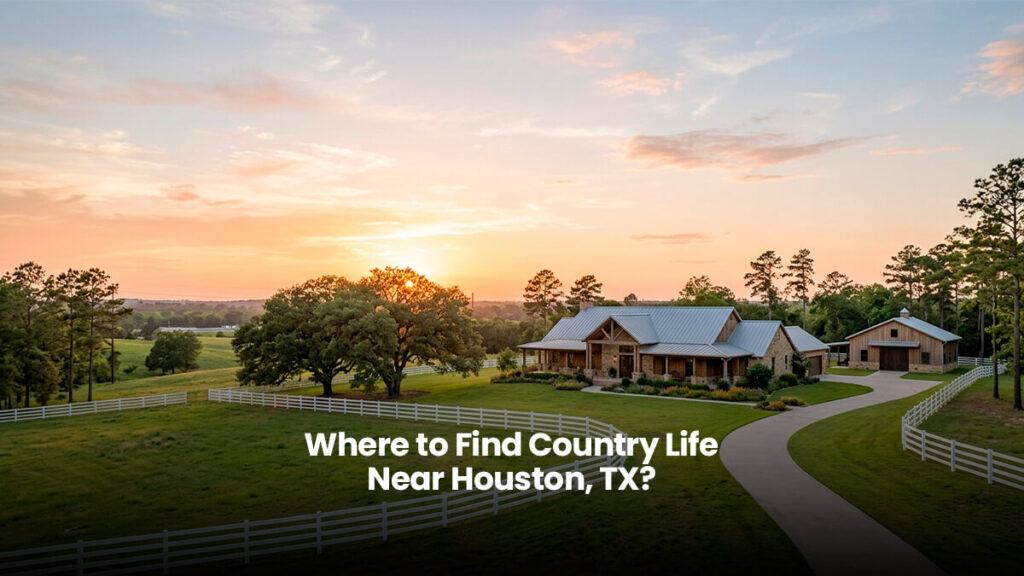
To find authentic country living near Houston, TX while keeping commute times between 45 to 75 minutes of the city, focus your search on Montgomery County (Montgomery, Willis, Magnolia), Waller County (Waller, Hempstead), Washington County (Brenham, Chappell Hill), and Austin/Fort Bend Counties (Sealy, Needville). These regions offer a spectrum of rural lifestyles—from 1-to-5-acre residential custom home lots in master-planned acreage communities to multi-acre working ranches with agricultural property tax exemptions, excellent public schools, and direct highway access via I-10, US-290, Grand Parkway (SH 99), and I-45.
Why Buyers Are Trading Houston City Lights for Country Life
Hi, I’m Aida Villalobos, your trusted Houston real estate expert. Over the past few years representing buyers, sellers, and land investors across the Greater Houston area, I’ve seen a massive shift in what people want from their home investment.
More than ever, buyers are coming to me asking: “Aida, where can I get 2+ acres, peace and quiet, a custom workshop or barn, and great schools—without moving to the middle of nowhere?”
The beauty of the Houston metropolitan region is that you don’t have to sacrifice urban amenities like Texas Medical Center access, energy corridor employers, or international airports to enjoy starry nights, fresh air, and open pastures. Whether you want a luxury equestrian estate, a barndominium on unrestricted land, or a cozy farmhouse in a quiet acreage subdivision, there is a rural pocket near Houston tailored to your goals.
Below, I’ve broken down the premier regions surrounding Houston where country living is thriving, complete with local context, commute expectations, and critical land-buying insights.
Top Geographic Regions for Country Living Near Houston
1. Montgomery & Grimes Counties (North / Northwest Corridor)
Featured Towns: Montgomery, Magnolia, Willis, Plantersville, Dobbin
Drive Time to Downtown Houston: 45 – 65 minutes (via I-45 or SH 249 / Aggie Expressway)
Landscape: Pine trees, rolling hills, forested acreage, proximity to Lake Conroe
If you love tall trees, rolling topography, and water recreation, the northern corridor is unbeatable. Montgomery is one of the oldest towns in Texas and retains immense historic charm alongside modern acreage developments. Magnolia has seen incredible accessibility improvements thanks to the SH 249 tollway extension, making commutes into the Energy Corridor or The Woodlands faster than ever.
In areas like Willis and Montgomery, you can find established acreage communities with 1-to-5-acre lots zoned to top-rated school districts like Montgomery ISD and Conroe ISD. For official municipal records, local zoning rules, and community resources, you can reference the Montgomery TX Official Portal.
2. Waller & Washington Counties (West / Northwest Corridor)
Featured Towns: Waller, Hempstead, Prairie View, Chappell Hill, Brenham
Drive Time to Downtown Houston: 50 – 75 minutes (via US-290 or Highway 6)
Landscape: Open prairie, wildflower-covered rolling hills, cattle pastures, pecan groves
Heading west along US-290 brings you into true Texas countryside. Waller County offers wide-open pasture land that remains relatively affordable compared to inner-loop prices, making it a hotspot for buyers seeking multi-acre homesteads, custom builds, and agricultural properties.
Continuing west into Washington County brings you to historic Chappell Hill and Brenham—famous for Blue Bell Ice Cream and spectacular bluebonnet fields in the spring. This area is ideal for buyers looking for weekend retreats, historic country homes, or full-scale ranches with elevation changes. You can explore regional cultural attractions and historic sites through the Visit Brenham & Washington County Guide.
3. Fort Bend & Austin Counties (West / Southwest Corridor)
Featured Towns: Sealy, Needville, Fulshear (outer edges), Richmond (rural outskirts), Wallis
Drive Time to Downtown Houston: 45 – 60 minutes (via I-10 West or US-59 / I-69)
Landscape: Flat to gently sloped fertile farmland, river basins, equestrian properties
For buyers who work along I-10 West or in the Westchase/Energy Corridor, Austin County (Sealy) and southern Fort Bend County (Needville) provide an ideal compromise. While Fulshear has grown rapidly into a suburban powerhouse, its outer boundaries still feature stunning acreage properties.
Communities in Sealy and Needville offer strong agricultural roots, active 4-H and FFA programs for youth, lower tax rates than master-planned suburban hubs, and quick drives back into Sugar Land or Katy for premier dining and shopping.
4. San Jacinto, Liberty & East Harris Counties (East / Northeast Corridor)
Featured Towns: Crosby, Huffman, New Caney, Cleveland, Coldspring
Drive Time to Downtown Houston: 40 – 60 minutes (via US-59 / I-69 North or US-90)
Landscape: Dense forest, coastal plains, proximity to Lake Livingston and Sam Houston National Forest
The northeast quadrant offers some of the most competitively priced acreage per square foot in the region. Towns like Huffman and Crosby border Lake Houston, offering riverfront and lake-adjacent country living. Further north in San Jacinto County near Coldspring, you’ll find deep piney woods, low light pollution, and easy access to national forest trails.
Houston Rural Living Comparison Table
| Region / Towns | Primary Access Route | Average Acreage Size | Best Suited For | Key Lifestyle Feature |
| Montgomery / Magnolia | I-45 / SH 249 | 1 – 10 Acres | Families, Woodlands Commuters | Wooded lots, Lake Conroe proximity |
| Waller / Hempstead | US-290 | 3 – 25+ Acres | Homesteaders, Custom Builds | Open pastures, easy commute to NW Houston |
| Brenham / Chappell Hill | US-290 West | 5 – 50+ Acres | Luxury Ranches, Retirees | Rolling hills, historic charm, scenic views |
| Sealy / Needville | I-10 / US-59 | 2 – 20 Acres | Equestrian Lovers, Ag Buyers | Flat fertile land, strong small-town schools |
| Huffman / Coldspring | US-59 / I-69 East | 1 – 15 Acres | Outdoor Enthusiasts, Value Seekers | Dense forest, proximity to lakes & national parks |
5 Essential Steps When Buying Country Property Near Houston
Navigating a rural property purchase is fundamentally different from buying a tract home in a Houston subdivision. As a Realtor who specializes in both residential and land transactions, here is the exact checklist I guide my clients through:
1. Verify Utility Infrastructure (Well & Septic)
Many country properties operate on private water wells and On-Site Sewage Facilities (OSSF/septic systems). During our inspection period, I always ensure we test well water quality, pump yield, and perform a thorough septic inspection to prevent costly post-closing surprises.
2. Understand Property Tax Exemptions (Ag & Wildlife)
One of the biggest financial benefits of owning land in Texas is the 1-d-1 Agricultural Appraisal Exemption. Properties qualified for Ag (cattle, hay production, beekeeping) or Wildlife Management are taxed on the land’s productive capacity rather than its market value, saving property owners thousands of dollars annually. You can learn more about land valuation standards via the official Texas A&M AgriLife Extension Service.
3. Check Restrictions vs. Unrestricted Land
“Unrestricted land” gives you maximum freedom—allowing workshops, multiple structures, livestock, or commercial usage. However, if you prefer paved roads, architectural consistency, and neighbor guidelines, an acreage subdivision with light deed restrictions may be the better fit. I review deed restrictions thoroughly with every client before submitting an offer.
4. Analyze Flood Zones & Drainage
Greater Houston’s flat terrain means drainage is critical. Before buying rural land, we evaluate FEMA flood maps, soil types (clay vs. sandy loam), and historical water flow. A country home sitting on high, dry ground preserves both your safety and your long-term resale value.
5. Confirm High-Speed Internet Connectivity
If you work remotely or stream daily, internet access is non-negotiable. While fiber optic internet is rapidly expanding into rural Waller, Montgomery, and Fort Bend counties, some remote pockets still rely on satellite providers like Starlink. We test connection options during your due diligence period.
To view current rural inventory, market trends, and localized listing data throughout these counties, you can cross-reference active listings on the official Houston Association of Realtors (HAR).
Frequently Asked Questions
How far do I need to drive from Houston to find affordable country land?
You can generally find true country acreage starting about 40 to 50 miles from Downtown Houston. Areas like Waller, Sealy, Willis, and Crosby offer rural settings within a 45-to-60-minute drive under normal traffic conditions.
Can I get an Agricultural Exemption on smaller land tracts (under 10 acres) near Houston?
Yes, but it depends on the county appraisal district’s specific guidelines and the agricultural use. For example, beekeeping qualifies for an Ag exemption in Texas on tracts between 5 and 20 acres. Traditional cattle or hay operations typically require larger acreage (often 10+ contiguous acres depending on the county).
What is the best area near Houston for horse owners and equestrian properties?
Montgomery County (specifically Magnolia and Montgomery) and Waller County are world-renowned for equestrian facilities, horse ranches, and riding trails. They feature sandy loam soil (which is gentler on horse hooves) and active equestrian communities.
Are country homes near Houston more expensive than city homes?
It varies by land size and improvement quality. Per square foot, the house itself may cost similarly, but land value adds to the total price. However, rural property taxes and lack of MUD taxes outside city limits often result in lower total monthly housing costs compared to luxury inner-loop homes.
What is the difference between an acreage subdivision and unrestricted land?
An acreage subdivision offers large lots (1 to 5+ acres) within a community framework that usually includes deed restrictions, paved streets, and sometimes an HOA. Unrestricted land has no architectural control committee or HOA, allowing you to build barndominiums, keep farm animals, add outbuildings, or run a home business.
Ready to Find Your Texas Country Sanctuary?
Finding the perfect balance of rural peace and urban accessibility requires deep local knowledge, land-specific expertise, and a clear strategy. Whether you’re buying your first 2-acre lot, upgrading to an equestrian estate, or investing in Texas land for the future, I am here to guide you through every step of the process.
Let’s start your search today!
Aida Villalobos | Agente inmobiliaria
📞(346) 955-1049 / @realtor.aidavillalobos