
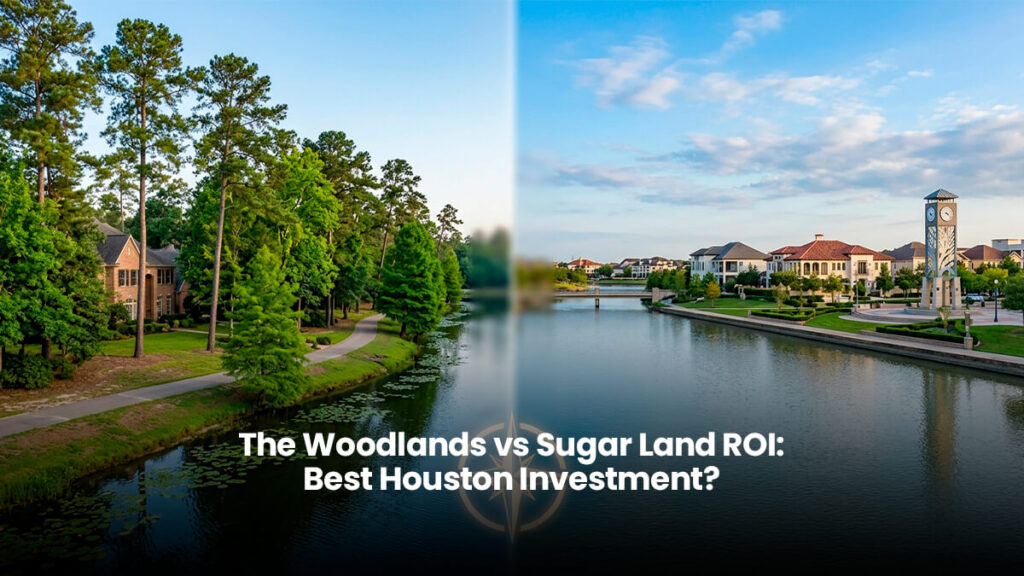
For long-term capital appreciation and wealth preservation, The Woodlands delivers superior historical growth driven by limited land inventory, corporate headquarters (like ExxonMobil), and top-tier Conroe ISD schools, albeit at a higher median purchase price (~$618,000–$650,000). For immediate cash-flow efficiency, lower entry price points (~$456,000–$491,000), and strong rental demand from Texas Medical Center commuters, Sugar Land offers a more favorable entry price-per-square-foot and resilient tenant demand across master-planned communities like Riverstone and First Colony.
The Woodlands vs Sugar Land ROI: Best Houston Investment?
As a real estate advisor guiding investors across the Greater Houston area, one question lands on my desk more than almost any other: “Aida, if I have capital to deploy in Houston’s suburban market, should I buy in The Woodlands or Sugar Land?”
Both of these master-planned powerhouses represent the crown jewels of Houston’s suburban real estate market. Both consistently rank among the best places to live in Texas, boasting top-rated public schools, ultra-low crime rates, and world-class amenities.
However, from an investment Return on Investment (ROI) perspective, total return is calculated differently in each area. A high-yield cash-flow strategy in Fort Bend County looks completely different from a wealth-preservation equity play in Montgomery County.
Below, I break down the market mechanics, tax structures, rental performance, and appreciation figures to help you select the ideal submarket for your portfolio.
At a Glance: Market Snapshot & Investment Data
To evaluate true ROI, we must look beyond purchase price and examine entry costs, speed of sale, and tax burdens across both markets. Data sourced via the Houston Association of Realtors (HAR) highlights key differences between these two destinations:
| Metric | The Woodlands, TX | Sugar Land, TX | Investment Impact |
| Median Single-Family Price | ~$618,000 – $650,000 | ~$456,000 – $491,000 | Sugar Land offers a ~30% lower barrier to entry. |
| Median Days on Market (DOM) | 11 – 22 Days | 15 – 30 Days | High demand drives quick inventory absorption in both areas. |
| Primary School District | Conroe ISD (Lower Tax Rate) | Fort Bend ISD | Conroe ISD offers a slight property tax savings (~0.10% lower). |
| Estimated Tax Stack Range | 1.70% – 1.91% (Excl. Creekside) | 1.84% – 1.99%+ (Incl. Levee/MUD) | MUD/LID fees alter net yield per neighborhood. |
| Primary Economic Drivers | Corporate HQs, Energy, Tech, Healthcare | Healthcare, Tech, TMC Commuters, Energy | Both attract stable, high-earning tenant bases. |
| Primary Investment Play | Equity Appreciation & Wealth Equity | Cash Flow Yield & Steady Occupancy | Dictates portfolio strategy alignment. |
Deep-Dive: The Woodlands Real Estate ROI Strategy
Founded as a visionary master-planned community, The Woodlands Township has evolved into a self-sustaining economic engine 28 miles north of Houston.
1. Supply Constraints & Equity Appreciation
Unlike typical Texas suburban markets where developer land spreads infinitely outward, The Woodlands is practically built out. Commercial and residential boundaries are strictly regulated. This structural land cap creates a natural floor under property values and accelerates long-term capital appreciation.
When you purchase in luxury enclaves like Carlton Woods, East Shore, or established villages like Alden Bridge and Sterling Ridge, you are investing in finite inventory.
2. Corporate Campus Anchors
The Woodlands is not merely a bedroom suburb; it is an employment center. With massive corporate presences including ExxonMobil’s Hughes Landing campus, Occidental Petroleum, and Huntsman Corporation, the executive housing market remains continuously active. High-earning corporate assignees drive long-term rental demand for premium single-family residences.
3. School District Draw
The majority of The Woodlands feeds into top-rated schools within Conroe ISD. Schools such as Woodlands High School and College Park High School are major magnets for relocating families, ensuring year-round buyer liquidity and high resalability.
Deep-Dive: Sugar Land Real Estate ROI Strategy
Located southwest of Downtown Houston in Fort Bend County, the City of Sugar Land represents one of the most successful suburban transformations in Texas history.
1. Price-per-Square-Foot Advantage & Yield
For real estate investors, Sugar Land offers superior price efficiency. A $500,000 investment in Sugar Land neighborhoods like First Colony, Greatwood, or New Territory secures a larger home with a higher rent-to-price ratio compared to the same capital deployed in The Woodlands. This price parity translates into stronger cash flow margins for buy-and-hold landlords.
2. Location & Medical Center Corridor
Sugar Land sits directly along the US-59 / I-69 corridor, providing direct access to the Texas Medical Center (the largest medical complex in the world) and the Energy Corridor. Medical professionals, researchers, and corporate executives choose Sugar Land for its reasonable commute times, creating a recession-resilient tenant base with high household incomes.
3. Master-Planned Excellence in Fort Bend County
Master-planned communities like Riverstone, Telfair, and Sweetwater maintain strict HOA guidelines that protect neighborhood aesthetics and long-term values. Combined with stellar education options in Fort Bend ISD, Sugar Land consistently attracts multi-year leases from established families.
Property Taxes & MUD Fees: The Hidden ROI Factor
When calculating net ROI in Texas, property tax structure is critical. Texas has no state income tax, meaning municipal services and schools are largely funded via property taxes.
Both submarkets feature a base tax stack made up of County, City/Township, and School District taxes. However, investors must pay special attention to MUD (Municipal Utility District) and LID (Levee Improvement District) assessments:
The Woodlands Tax Stack: Conroe ISD’s tax rate sits lower than Fort Bend ISD’s rate. Additionally, older villages in The Woodlands have fully paid off their underlying MUD debt, keeping effective tax rates between ~1.70% and 1.91%. (Note: Creekside Park sits in Harris County/Tomball ISD and carries a higher tax stack around ~2.43%).
Sugar Land Tax Stack: While Sugar Land’s city portion offers a homestead exemption for primary owners, investment properties do not qualify. Base rates hover around ~1.84%, but properties in newer developments or sections inside Levee Improvement Districts (e.g., First Colony LID 2) can see effective rates push toward ~1.99%–2.20%.
Aida’s Investor Tip: Always verify the precise tax rate and active MUD bond payoff schedule for any specific address before submitting an offer, as a 0.30% variation in taxes directly impacts your annual cap rate!
Step-by-Step: How I Help Investors Choose Their Best Fit
To determine whether The Woodlands or Sugar Land best fits your portfolio, follow this step-by-step decision framework:
Define Your Primary ROI Goal:
If your goal is maximum equity growth and wealth preservation over a 7–10 year horizon, target The Woodlands.
If your goal is cash flow yield, lower initial capital exposure, and steady tenant demand, target Sugar Land.
Analyze Your Capital Budget:
Capital under $500,000: Sugar Land offers significantly more single-family opportunities with strong rental metrics.
Capital over $650,000+: The Woodlands opens up executive-tier housing with premium long-term resale potential.
Calculate Net Yield (The Full Stack):
Deduct exact county appraisal taxes, HOA dues, MUD debt, and landlord insurance (considering flood zone designations, as both communities feature localized watersheds).
Partner with a Local Specialist:
Work with a hyper-local advisor who understands micro-neighborhood dynamics down to the street and village level.
Frequently Asked Questions
Which submarket offers higher long-term appreciation: The Woodlands or Sugar Land?
Historically, The Woodlands has generated slightly higher rates of equity appreciation due to strict geographic build-out limits, high corporate headquarters concentration, and higher median price ceilings. However, mature Sugar Land neighborhoods (such as Sweetwater and Telfair) also demonstrate strong long-term price stability and consistent demand.
How do rental yields compare between Sugar Land and The Woodlands?
Sugar Land typically delivers higher net rental yields and cash-on-cash returns. Because entry prices per square foot are lower than in The Woodlands, landlords can secure competitive monthly rents relative to their purchase price. In The Woodlands, higher acquisition costs slightly compress cap rates, shifting the ROI emphasis toward capital growth.
What is the effect of MUD taxes on real estate investment in Houston suburbs?
Municipal Utility District (MUD) taxes cover infrastructure, water, and drainage development. In newer subdivisions, high MUD rates increase annual operating expenses and reduce net cash flow. In mature areas of both Sugar Land and The Woodlands where MUD bonds are paid down, lower tax burdens immediately boost landlord net operating income (NOI).
Is flood risk a major investment factor in The Woodlands and Sugar Land?
Both communities feature engineered flood mitigation infrastructure—including levee systems in Sugar Land and master-planned drainage basins in The Woodlands. Flood risk is hyper-local and varies neighborhood by neighborhood. As your realtor, I evaluate base flood elevations, FEMA map updates, and historical storm performance for every property under consideration.
Ready to Invest in Houston Real Estate?
Whether you are leaning toward the wooded luxury of Montgomery County or the strategic convenience of Fort Bend County, navigating Greater Houston’s real estate market requires local expertise and precise data.
I am Aida Villalobos, your dedicated Houston real estate advisor. My team and I specialize in helping local and out-of-state investors identify high-performing single-family properties, analyze real tax stacks, and build long-term real estate wealth across The Woodlands, Sugar Land, and Greater Houston.
Contact me today to review current off-market opportunities and custom ROI analyses for your portfolio.
Aida Villalobos | Real Estate Broker
📞(346) 955-1049 / @realtor.aidavillalobos