
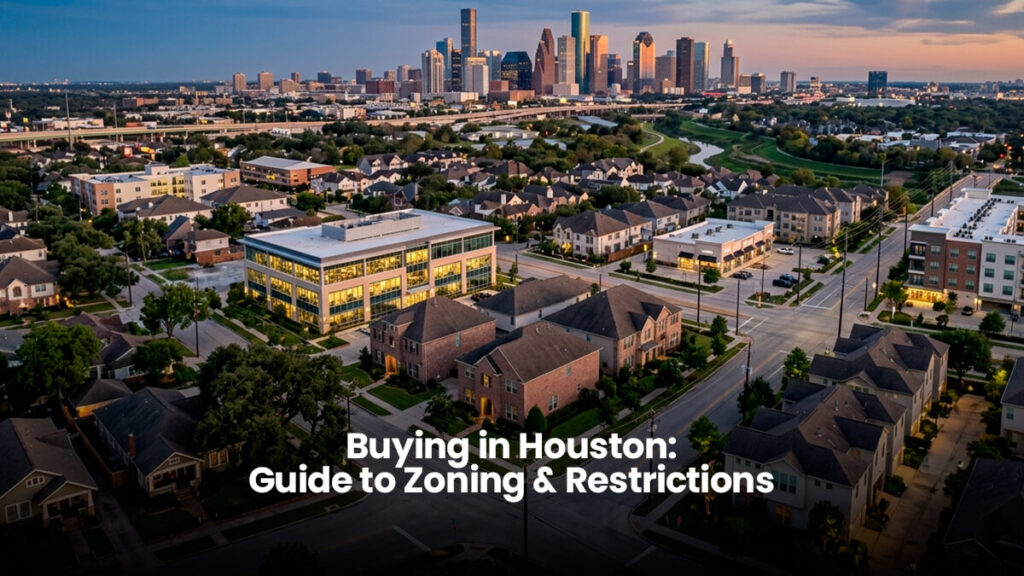
If you are planning to buy a home or invest in commercial property in the Space City, you have probably heard the famous rumor: “Houston has no zoning laws!” As a licensed realtor here in Houston, Texas, I hear this from out-of-state buyers almost every single week.
While it is technically true that Houston is the largest city in the United States without a formal, traditional municipal zoning code, don’t let that fool you into thinking it’s a free-for-all wild west. Houston is highly regulated; we just do things a little differently through a complex web of land-use restrictions, subdivision ordinances, and private deed restrictions.
Understanding how these rules dictate what you can and cannot build—or who your next-door neighbor might be—is absolutely critical to protecting your investment. Let’s break down exactly how land use works in our market so you can navigate your next purchase with complete confidence.
The Myth of the “Zoning-Free” City
When people think of traditional zoning, they think of cities like New York or Los Angeles, where the local government strictly draws lines on a map separating residential neighborhoods from commercial strips and industrial plants. Houston voters have famously rejected attempts to implement official city zoning three separate times in our history.
Instead of a centralized government master plan, our city relies heavily on deed restrictions (private contracts attached to the land) and municipal ordinances that govern how close a building can be to the street, how many parking spaces it must provide, and how dense a residential development can be.
This unique approach has allowed Houston to grow organically into a dynamic, highly flexible metropolis, but it also means that a luxury high-rise condominium, a trendy taco truck, and a single-family home can occasionally end up on the very same block. For buyers, this makes doing proper due diligence non-negotiable.
Deed Restrictions and HOAs: Houston’s Hidden Zoning
Because the City of Houston doesn’t tell landowners they can’t put a retail boutique next to a house, private developers took matters into their own hands decades ago. They created deed restrictions, which are legally binding covenants embedded into the property deeds themselves.
When you buy a home in established Houston communities like The Heights, River Oaks, or newer master-planned suburbs like The Woodlands and Cinco Ranch, you are signing up to follow these private rules. In fact, the City of Houston Legal Department has unique statutory authority to enforce these private deed restrictions just like municipal laws, protecting residential neighborhoods from commercial encroachment.
These covenants are usually managed by a Homeowners Association (HOA) and can restrict everything from:
Whether you can use your property as a short-term rental or home business.
The exact paint colors you can use on your exterior walls.
The height, architectural style, and square footage of any additions.
Where you can park your vehicle, boat, or RV.
Before you fall in love with a property, I always make sure we pull the specific HOA bylaws and deed restrictions during your option period to ensure your long-term plans align with the neighborhood rules.
City Ordinances: Chapter 26 and Chapter 42
Even outside of deed-restricted neighborhoods, the city government maintains significant control over development through the Houston Code of Ordinances. The two most vital pieces of legislation for property owners to know are Chapter 26 and Chapter 42.
Chapter 42: Subdivision and Development
This is the ordinance that dictates how land can be subdivided and developed within the city limits and its Extra-Territorial Jurisdiction (ETJ). It regulates building setbacks (how far back a structure must sit from the property line) and lot sizes. In recent years, amendments to Chapter 42 have allowed developers to build high-density townhomes on much smaller lots within the Interstate 610 loop, transforming the urban landscape of areas like Midtown, Montrose, and Washington Corridor.
Chapter 26: Off-Street Parking
You cannot simply open a business or expand a residential structure without addressing parking. Chapter 26 sets strict rules on how many dedicated off-street parking spaces a building must provide based on its structural square footage and usage type. A restaurant, for instance, requires significantly more parking spaces than a retail warehouse. This single ordinance often stops commercial projects in their tracks more effectively than standard zoning would.
Environmental and Historic Protections
Beyond land-use regulations, buying real estate in Houston requires a deep understanding of environmental overlays, particularly regarding flood plains and historic preservation.
Floodplain Regulations
Following major weather events, the city implemented rigorous development codes via Chapter 19 of the Code of Ordinances. If you buy or build a home located within the 100-year or 500-year floodplains, the Federal Emergency Management Agency (FEMA) and local municipal codes require new structures or substantial improvements to be elevated well above the base flood elevation. This significantly impacts construction costs and insurance premiums, which we must factor into your purchasing budget.
Historic Districts
If you are looking at historic properties in neighborhoods like the Houston Heights, Old Sixth Ward, or Norhill, you must navigate the Houston Archaeological and Historical Commission (HAHC). Properties inside designated historic districts require a Certificate of Appropriateness before making any exterior modifications, ensuring that the rich architectural heritage of the area remains intact.
Frequently Asked Questions (FAQ)
Can a business open right next to my house in Houston? If your property is located within a subdivision protected by active residential deed restrictions, commercial businesses are legally barred from operating there. However, if you buy a home in an unrestricted pocket of the city, it is entirely possible for a commercial business, office, or multi-family complex to open on an adjacent lot.
How do I check the restrictions on a Houston property before buying? During the purchasing process, we will secure a comprehensive title commitment from the title company. This document outlines all active covenants, conditions, and restrictions (CCRs) attached to the land. You can also utilize public record resources provided by the Harris Central Appraisal District (HCAD) to check ownership records and legal descriptions.
What happens if I violate a deed restriction in Houston? Because the City of Houston actively assists in enforcing deed restrictions, consequences can be severe. Violations can result in steep daily fines, lawsuits from either your neighbors, your HOA, or the city attorney, and legal orders forcing you to dismantle unapproved modifications at your own expense.
What is the “ETJ” and does it have rules? The Extra-Territorial Jurisdiction (ETJ) is the unincorporated land extending up to 5 miles outside Houston’s official city limits. While these areas do not have city services, they are still subject to Houston’s Chapter 42 subdivision rules, meaning developers must still get plat approvals before building.
Conclusion
As you navigate the exciting journey of purchasing property in Houston, it is essential to look past the “no zoning” headlines and understand the actual regulatory framework that shapes our unique landscape. While the lack of a traditional municipal zoning code offers unparalleled flexibility and dynamic growth, it places a higher responsibility on you as a buyer to conduct thorough due diligence.
By familiarizing yourself with private deed restrictions, HOA covenants, and the specific city ordinances like Chapter 42 and Chapter 26, you gain the power to protect your investment and ensure that your property aligns with your long-term goals. Houston is a city that rewards the informed—whether you are looking for a historic gem, a high-density townhome, or a commercial opportunity, understanding the rules of the game is your greatest asset. If you are ready to explore the market with a partner who understands the nuances of Houston’s land use and regulations, I am here to guide you every step of the way toward a successful and secure acquisition.
Aida Villalobos | Real Estate Broker
📞(346) 955-1049 / @realtor.aidavillalobos