
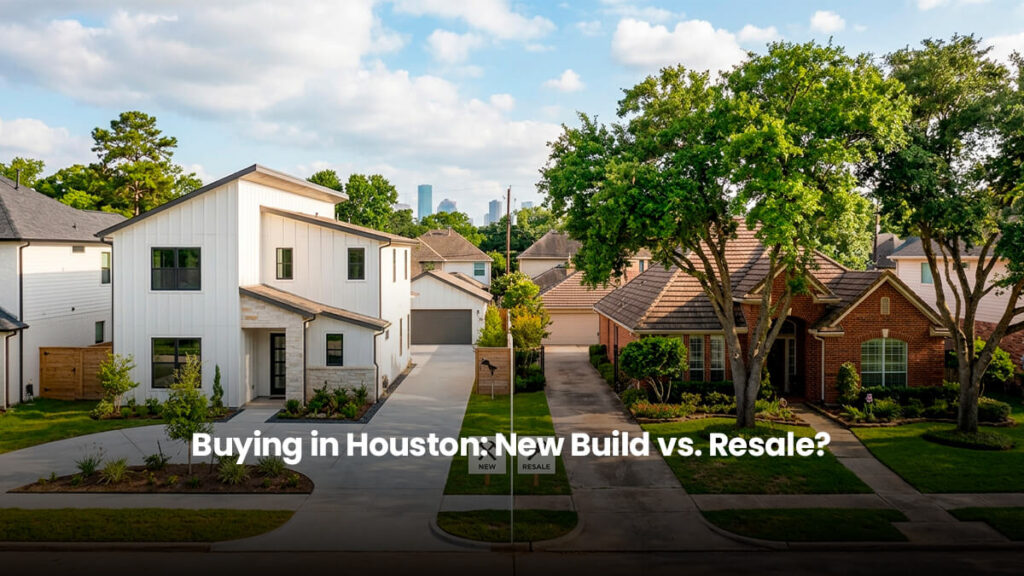
Choosing between a new build and a resale home in Greater Houston comes down to location, initial capital, and total monthly carrying costs. New construction offers modern layouts, energy efficiency, builder warranties, and attractive financing incentives (like rate buydowns near 4.99%). However, new developments often sit further out in suburban master-planned communities with higher Municipal Utility District (MUD) property taxes ($1.20–$1.50 per $100 value). Resale homes provide established locations (closer to Inner Loop employment hubs), larger lots, mature trees, and lower tax rates, but require higher maintenance budgets for aging HVAC, roof, or foundation systems.
Buying in Houston: New Build vs. Resale?
As a licensed Houston Realtor®, the single most common debate my clients bring to the table is: “Aida, should we buy a brand-new build in the suburbs or look for a resale home with character in an established neighborhood?”
Greater Houston is one of the most dynamic, fast-growing housing markets in the United States. According to market updates from the Houston Association of REALTORS® (HAR), median home prices for existing single-family homes sit around $345,000, while new construction trades at similar median levels—yet their underlying carrying costs couldn’t be more different.
Whether you are looking at master-planned communities in Cypress and Katy or charming properties in The Heights, Montrose, or Sugar Land, deciding between new construction and resale isn’t just about granite countertops versus quartz. It is a long-term financial decision involving property taxes, infrastructure districts, commute times, and maintenance costs.
Here is my definitive guide as your local Houston real estate advisor to help you determine which path best fits your family’s goals.
1. The Financial Reality: Sticker Price vs. True Monthly Carrying Cost
When comparing two homes listed at $450,000—one brand new in Fulshear and one 15-year-old resale in Katy—most buyers assume their monthly payments will be identical. In Houston, that is rarely the case.
Total Monthly Carry = (Principal + Interest) + (Property Taxes) + (HOA/MUD Levies) + (Insurance/Maintenance)
The Houston MUD & PID Factor
In Texas, master-planned developments built on newly developed land use Municipal Utility Districts (MUDs) or Public Improvement Districts (PIDs) to fund water, sewer, and road infrastructure.
New Build MUD Rates: Young MUD districts in growing submarkets like Bridgeland or Elyson can add $1.20 to $1.50 per $100 of assessed property value. On a $500,000 home, that MUD line item alone adds $6,000 to $7,500 per year to your property tax bill.
Resale Tax Advantage: In mature neighborhoods where MUD bonds have amortized or inside Houston city limits, overall effective tax rates verified through the Harris Central Appraisal District (HCAD) are typically significantly lower.
Builder Rate Buydowns vs. Price Negotiation
To move new construction inventory, major builders in Greater Houston frequently offer promotional financing, such as 3-2-1 permanent or temporary rate buydowns (dropping interest rates below market rates), along with closing cost contributions.
While a builder financing incentive can save you $400–$500 per month in mortgage interest, a higher suburban MUD tax rate can offset those savings. As your Realtor, I calculate the net effective carry over a 5-to-10-year horizon before we sign any contract.
2. Side-by-Side Comparison: New Construction vs. Resale in Houston
| Feature | New Construction Home | Resale Home |
| Location & Commute | Suburbs, outer loops (Grand Parkway / Hwy 290 / I-10 West) | Inner Loop, established close-in suburbs (The Heights, Bellaire, Sugar Land) |
| Move-in Timeline | 6–12 months for ground-up; 30–60 days for quick move-in inventory | 30–45 days standard closing timeline |
| Upfront Builder Incentives | High (rate buydowns, design center credits, closing costs) | Moderate (seller concessions, repairs, price cuts) |
| Property Tax Structure | Higher due to active MUD/PID bond debt | Lower effective rates in established infrastructure districts |
| Initial Upkeep & Warranty | Low; includes 1-2-10 year Texas builder warranty | Moderate to High; immediate roof, HVAC, or cosmetic updates possible |
| Energy Efficiency | High (current energy codes, spray foam insulation, double-pane Low-E windows) | Variable (may require HVAC upgrades, window replacement, or air sealing) |
| Lot Size & Trees | Smaller lot footprints, young saplings | Larger lots, mature canopy, established privacy |
3. Deep Dive: New Construction in Houston
The Advantages
Modern Living & Energy Efficiency: New builds comply with the latest building codes. In Houston’s humid summers, modern high-efficiency HVAC systems, radiant barrier roof decking, and tankless water heaters mean drastically lower electric bills.
Personalization: Building from the ground up lets you choose floor plans, tile, cabinetry, and structural options like extended covered patios or home offices.
Peace of Mind: Most builders provide a structural warranty (typically 1 year on workmanship, 2 years on mechanical systems, and 10 years on major structural components).
The Hidden Pitfalls Buyers Miss
Post-Closing Missing Essentials: New builds rarely come with window blinds, garage door openers, full backyard landscaping, or gutting/fencing additions. Expect to spend $5,000–$15,000 post-closing on these “invisible extras.”
Construction Delays & Supply Chain: Ground-up builds can run past initial estimates. If you have a strict lease expiration, a quick move-in inventory home or resale is often a safer bet.
Independent Inspections Are Still Essential: Many buyers think brand-new means zero defects. Independent third-party inspections during pre-pour foundation, pre-drywall, and final walk-through stages are essential to catch construction oversights.
4. Deep Dive: Resale Homes in Greater Houston
The Advantages
Prime Locations & Shorter Commutes: Resale homes occupy prime Houston land—whether in walkable Inner Loop neighborhoods like Spring Branch and Oak Forest or core suburban master plans like First Colony in Sugar Land.
Established Neighborhood Character: You get mature oak trees, established neighbor networks, completed community amenities, and proven school track records.
Immediate Move-In & Value Add Potential: You can close in 30 days and build instant sweat equity through cosmetic upgrades.
What to Watch Out For in Houston Resales
Houston Clay Soil & Foundations: Houston sits on reactive clay soil that expands when wet and contracts when dry. Older resale homes require careful foundation evaluations, plumbing static tests, and proper drainage systems (like French drains).
Aging Systems: A 15-year-old home may require near-future capital expenditures: HVAC replacement ($8,000–$14,000), roof replacement ($10,000–$20,000), or water heater updates.
Insurance Costs: Older roofs or legacy electrical systems (such as aluminum wiring in 1970s builds) can lead to higher home insurance premiums in the Texas Gulf Coast region.
5. Step-by-Step: How I Help My Clients Choose
To decide whether a new build or resale fits your life, follow this 4-step framework:
Step 1: Calculate Your Hard Commute Tolerance
   │
   ├──> Long commute OK for more space/newness? ──> Explore Suburban New Builds
   └──> Must stay within 30 min of Downtown/Galleria/Med Center? ──> Target Resale
   │
Step 2: Run the Net Monthly Tax & Financing Math
   │
   ├──> High MUD Tax + Low Rate Buydown vs. Low Tax + Standard Rate
   └──> Compare total monthly outlay with HCAD tax assessments
   │
Step 3: Audit Your Out-of-Pocket Capital Reserves
   │
   ├──> Prefer predictable costs & warranties? ──> New Construction
   └──> Have cash reserves for repairs/renovations? ──> Resale Opportunity
   │
Step 4: Conduct Independent Inspections (On BOTH Options)
   │
   └──> Review TREC property disclosures & hire certified inspectors
Step 1: Calculate Your Hard Commute Tolerance. If working in the Texas Medical Center, Energy Corridor, or Downtown Houston, test the drive during peak hours (7:30 AM and 5:00 PM).
Step 2: Run the Net Monthly Tax & Financing Math. Do not look at listing price alone. Combine principal, interest, homeowner’s insurance, HOA dues, and specific county/MUD tax rates.
Step 3: Audit Your Out-of-Pocket Capital Reserves. If you lack a cash cushion for immediate repairs post-closing, new construction with builder warranties offers financial safety. If you have renovation funds, resale offers custom upside potential.
Step 4: Engage Independent Professional Representation. Always work with an experienced agent who understands Texas real estate disclosures regulated by the Texas Real Estate Commission (TREC).
6. Local Submarket Breakdown
Suburban Growth Corridors (New Build Champions)
Cypress & Katy (Bridgeland, Elyson, Cane Island): Top-rated school districts (Cypress-Fairbanks ISD, Katy ISD), resort-style amenities, but higher MUD tax rates.
Fulshear & Montgomery/Conroe (Woodforest, Grand Central Park): Rapid expansion, new commercial centers, modern floor plans, longer commutes into central Houston.
Established & In-Town Communities (Resale Champions)
Inner Loop (The Heights, Montrose, Rice Military): Walkability, rich culture, historic charm, zero MUD taxes, but higher price-per-square-foot and older homes.
Master-Planned Classics (Sugar Land, The Woodlands, Kingwood): Fully built-out communities with mature tree canopies, stable tax bases, excellent schools, and strong resale demand.
To learn more about Houston’s economic expansion and submarket growth drivers, explore research published by the Greater Houston Partnership.
7. Frequently Asked Questions
Do I need a Realtor when buying a new construction home in Houston?
Yes. The sales representative in a model home works exclusively for the builder’s bottom line—not yours. Having me represent you costs you nothing extra (the builder pays agent commissions out of a separate marketing budget) and ensures you have an advocate negotiating price, lot premiums, builder incentives, and inspection repairs.
Are property taxes higher on new homes in Houston?
Generally, yes. While the base tax rate set by Harris, Fort Bend, or Montgomery County remains standard, new master-planned communities usually carry additional MUD or PID taxes to pay for infrastructure. Always verify the total combined tax rate for the specific address.
Can you negotiate prices on new construction homes with builders?
While builders rarely lower the official base list price (as it impacts appraised values for future sales in the community), they are often flexible on concessions. You can negotiate builder-paid closing costs, interest rate buydowns, design center upgrades, or free appliances.
Which option holds better long-term resale value in Houston?
Both options appreciate well when purchased in desirable school districts and growth corridors. Resale homes in land-constrained inner suburbs (like Spring Branch or Sugar Land) often experience steady land value appreciation, while new homes in suburban master plans benefit from modern master-planned amenities and initial low maintenance costs.
Ready to Make Your Move in Houston?
Whether you fall in love with a brand-new master-planned community or a character-filled resale home, navigating the Greater Houston market requires local knowledge, clear tax math, and strategic negotiation.
I’m Aida Villalobos, your trusted Houston Realtor®. My goal is to guide you through every step of the process so you make a confident, profitable investment for your family’s future.
Let’s find your ideal Houston home together.
Aida Villalobos | Real Estate Broker
📞(346) 955-1049 / @realtor.aidavillalobos