
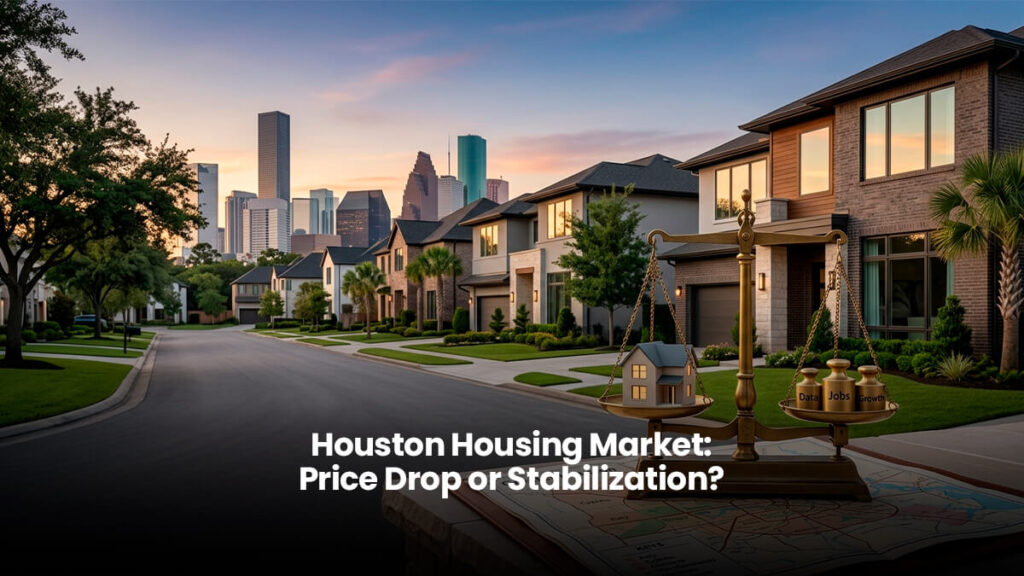
If you have been keeping an eye on local real estate headlines or scrolling through social media lately, you have probably seen conflicting stories about what is happening in the Greater Houston real estate market. Some headlines dramatically warn of a price drop, while others predict a resilient boom.
As a licensed Houston Realtor working with buyers, sellers, and investors across our region every single day, I prefer to cut through the noise with facts, verified local data, and boots-on-the-ground experience.
So, what is really happening right now? Are home prices dropping in Houston, or are we finally experiencing market stabilization? Let’s dive straight into the numbers and what they mean for your next move.
The Verdict: The Greater Houston housing market is experiencing market stabilization and normalization, not a price crash. While median prices have shown minor single-digit adjustments (between -0.9% and -1.5% year-over-year), active inventory has expanded to around 4.8 to 5.2 months of supply. This shift signals a healthy return to equilibrium, giving buyers more negotiating leverage while preserving solid, long-term home equity for sellers.
Looking at the Hard Data: Price Drop vs. Stabilization
To understand where our market stands, we have to examine the official monthly statistics published by the Houston Association of REALTORS® (HAR) alongside broader Texas economic indicators tracked by the Texas Real Estate Research Center at Texas A&M University.
When people hear that active listings are rising or that days on market are longer, the knee-jerk reaction is to assume prices are plummeting. However, a close look at the key indicators reveals a classic transition from an overheated seller’s market toward a balanced, sustainable environment.
Key Houston Real Estate Market Metrics
| Market Indicator | Current Houston Baseline | Year-Over-Year Change | What It Means for You |
| Median Single-Family Home Price | ~$332,000 – $345,000 | -0.9% to -1.5% | Prices are flat to slightly softer, preventing runaway inflation. |
| Average Single-Family Home Price | ~$415,000 – $428,000 | -1.4% to +2.0% | High-end luxury properties remain steady. |
| Active Residential Listings | ~35,000 – 55,000 total listings | +6.9% to +14.3% | Significantly more choices for buyers; less buyer fatigue. |
| Months Inventory of Housing | 4.8 to 5.2 Months | Up from 4.3 months | Reaching textbook market balance (5 to 6 months is balanced). |
| Average Days on Market (DOM) | 52 to 69 Days | Increased 5–14 days | Sellers must price correctly; buyers have breathing room to inspect. |
| Pending Sales Volume | Up consistently year-over-year | +3.3% to +13.0% | Strong underlying buyer demand continues across price points. |
As these numbers demonstrate, we are seeing price stabilization, not a market collapse. Moderate price growth or slight leveling allows wage growth and mortgage rate adjustments to restore affordability.
Why Houston’s Market Structure Prevents a Housing Crash
As a Realtor, clients frequently ask me: “Aida, is Houston going to experience a 2008-style crash?”
My answer is a confident no. The fundamental economic drivers supporting Greater Houston today are vastly different from previous downturns:
Job Diversity and Regional Growth: Houston is no longer dependent solely on traditional energy cycles. According to economic research from the Greater Houston Partnership, our region has expanded rapidly in life sciences, healthcare (the Texas Medical Center), aerospace, clean energy, and international logistics.
In-Migration Trends: Texas continues to draw thousands of corporate relocations and new residents annually due to no state income tax, competitive cost of living, and job creation.
Strict Underwriting Standards: Unlike the mid-2000s, today’s homeowners possess strong credit profiles and record amounts of home equity, drastically reducing foreclosure risks.
Normalized Inventory Levels: While active inventory has grown, Federal Reserve economic tracking from FRED Economic Data confirms that national and local housing supply remains far below levels that would trigger distressed oversupply.
How Neighborhood Trends Vary Across Houston
In a region as sprawling as Greater Houston, there is no single “Houston housing market.” Real estate is hyper-local. What is happening in suburban master-planned developments differs from close-in urban corridors.
1. Inner Loop & Urban Core (The Heights, Montrose, EaDo, Rice Military)
Demand for walkable, close-in properties remains resilient. Townhomes and single-family historic homes in neighborhoods like Houston Heights, Montrose, and EaDo continue to see steady interest from young professionals and medical staff working nearby. While condo inventory has expanded slightly, premier single-family properties in top school pockets (like West University or River Oaks) maintain high demand.
2. West & Northwest Suburbs (Katy, Cypress, Fulshear, Bridgeland)
The suburban corridors along I-10, Highway 290, and the Grand Parkway (SH 99) are seeing the most inventory expansion. Master-planned communities in Katy and Cypress are offering buyers incredible choices in new construction and resale homes. Builders are stepping up with incentives such as interest rate buydowns and closing cost assistance to maintain sales momentum.
3. North & East Suburbs (The Woodlands, Spring, Conroe)
The Woodlands and surrounding North Houston enclaves remain seller-favored micro-markets due to geographic constraints, mature trees, exemplary school districts, and corporate headquarters (such as ExxonMobil). Well-maintained homes in established villages still move quickly when priced accurately.
4. South & Southwest Suburbs (Sugar Land, Missouri City, Pearland)
Sugar Land and Pearland offer established neighborhoods, top-tier schools, and straightforward commutes to the Texas Medical Center or Downtown. These markets have normalized into healthy, balanced zones where realistic pricing leads to smooth transactions.
Strategic Action Steps for Buyers and Sellers
Whether you plan to buy your first home or sell a property to move up, navigating a stabilized market requires a refined strategy.
For Homebuyers: How to Capitalize on Market Stabilization
Take Advantage of Choice: With inventory near 5 months of supply, you no longer need to rush into waived inspections or impulse offers. Take time to evaluate floor plans, lot sizes, and HOA restrictions.
Negotiate Buyer Incentives: Sellers and builders are willing to negotiate again. Ask for seller credits toward temporary rate buydowns (like a 2-1 buydown) or closing costs.
Get Pre-Approved Early: Work with a trusted local mortgage lender to establish your exact budget and examine how interest rate fluctuations impact your monthly payment.
For Home Sellers: How to Succeed in a Normalized Market
Price Based on Current Comps, Not Past Peaks: Pricing your home based on the frantic bidding-war prices of previous years will cause your home to sit on the market. Work with an expert Realtor to analyze active competition and recent pending sales.
Invest in Staging and Preparation: In a market with elevated inventory, presentation is everything. Professional photography, deep cleaning, minor paint touch-ups, and staging will set your listing apart.
Be Open to Negotiation: Be prepared to discuss repair requests, closing timeline flexibility, or seller concessions to cross the finish line smoothly.
Frequently Asked Questions
Is the Houston real estate market going to crash in 2026?
No. Current data from HAR and Texas A&M shows market stabilization, not a crash. Strong regional job growth, disciplined lending practices, and steady population growth provide a solid foundation for home values.
Are home prices dropping in Houston, Texas?
Home prices are not dropping significantly across the board. Instead, overall appreciation has leveled off, with median home prices adjusting marginally (-0.9% to -1.5%) as inventory increases. This is a healthy correction that helps restore housing market equilibrium.
Is it currently a buyer’s or seller’s market in Houston?
Greater Houston is currently in a balanced housing market. With approximately 4.8 to 5.2 months of housing inventory, neither buyers nor sellers hold overwhelming leverage. This environment rewards buyers with more options and gives sellers stable home values when priced properly.
How long are homes staying on the market in Houston?
The average Days on Market (DOM) in Greater Houston currently ranges between 52 and 69 days, depending on the price point, condition, and neighborhood. This reflects a return to traditional, healthy sales timelines.
Partnering with a Local Houston Expert
Navigating real estate shifts requires context, local market knowledge, and clear analysis. As your dedicated Houston Realtor, my goal is to protect your equity, maximize your purchasing power, and guide you through every phase of buying or selling a home across Greater Houston.
If you are curious about what your specific neighborhood or home is worth in today’s stabilized market, or if you are ready to explore available homes in Katy, Cypress, The Heights, or beyond, let’s connect!
Aida Villalobos | Real Estate Broker
📞(346) 955-1049 / @realtor.aidavillalobos