
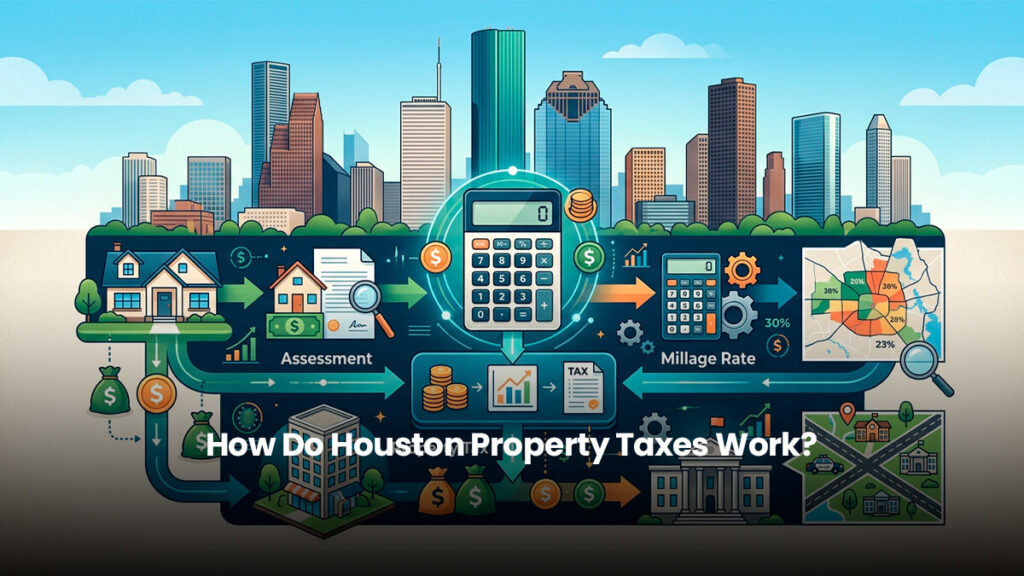
Houston property taxes are calculated annually by multiplying your home’s taxable value (appraised value set by appraisal districts minus applicable exemptions) by the combined tax rate of your local taxing authorities (school district, county, city, hospital district, and special utility districts). Because Texas has no state income tax, property taxes fund local public services, with average effective tax rates ranging between 1.8% and 2.5% of a home’s market value. Homeowners can significantly lower their annual bill by claiming the Texas General Residence Homestead Exemption and protesting inflated appraisal values.
Hi, I’m Aida Villalobos, your trusted Houston real estate expert. When clients relocate to Houston or buy their first home in our vibrant communities—whether in the Heights, Katy, Sugar Land, or Cypress—the most common question I get is: “Aida, how do property taxes actually work here?”
Understanding property taxes in Greater Houston is essential for budgeting accurately, managing your monthly mortgage payment, and protecting your equity. Here is my complete, step-by-step local guide to mastering Houston property taxes.
1. The Core Formula: How Houston Property Taxes Are Calculated
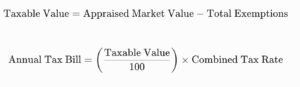
Texas property taxes are based on the ad valorem system, meaning “according to value.” Your total tax liability depends on two main variables: your home’s assessed taxable value and the total tax rate determined by overlapping taxing units.
The fundamental math formula is:
Sample Tax Calculation for a Houston Home
To see this in practice, consider a single-family primary residence in the City of Houston within the Houston Independent School District (HISD) with an appraised value of $350,000 and a standard homestead exemption:
| Taxing Entity | Appraised Value | Exemption Amount | Taxable Value | Tax Rate (per $100) | Estimated Tax Bill |
| Houston ISD (School) | $350,000 | $140,000 (State Exemption) | $210,000 | $0.8783 | $1,844.43 |
| City of Houston | $350,000 | $70,000 (20% Local Option) | $280,000 | $0.5192 | $1,453.76 |
| Harris County | $350,000 | $70,000 (20% Local Option) | $280,000 | $0.3853 | $1,078.84 |
| Harris Health System | $350,000 | $70,000 (20% Local Option) | $280,000 | $0.1876 | $525.28 |
| Flood Control District | $350,000 | $70,000 (20% Local Option) | $280,000 | $0.0497 | $139.16 |
| TOTAL ESTIMATED TAX | — | — | — | ~2.02% Combined Effective | $5,041.47 |
2. Who Taxes You in Houston? Local Entity Breakdown
Your tax bill isn’t paid to a single government office; it is a compilation of rates from several distinct governing bodies servicing your specific neighborhood.
Key Assessment Authorities
Appraisal Districts: County appraisal districts determine your property’s fair market value as of January 1 each year.
Harris Central Appraisal District (HCAD) services properties in Harris County.
Fort Bend Central Appraisal District services Fort Bend County areas like Sugar Land and Missouri City.
Montgomery Central Appraisal District covers North Houston and The Woodlands.
Tax Assessor-Collectors: Collecting agencies, such as the Harris County Tax Assessor-Collector, send bills and distribute funds to taxing jurisdictions.
State Oversight: Guidance and statutory compliance are overseen by the Texas Comptroller of Public Accounts.
What Is a MUD Tax?
If you purchase a home in newer suburban developments across Katy, Cypress, Humble, or Towne Lake, your property might be located inside a Municipal Utility District (MUD). MUDs are political subdivisions that issue bonds to fund water, sewer, drainage, and road infrastructure before a city annexes the territory.
Impact: MUD tax rates typically add between $0.30 and $1.00+ per $100 of assessed value on top of standard county and school taxes.
Advantage: MUD districts generally offer newer infrastructure, resort-style community amenities, and master-planned layouts.
3. How to Lower Your Tax Bill: Texas Homestead Exemptions & Caps
As your realtor, my job doesn’t end when I hand you the keys; I want to ensure you keep your ongoing housing expenses as low as possible. Filing for property tax exemptions is the single most effective way to cut your annual bill.
Available Texas Property Tax Exemptions
General Residence Homestead Exemption: Available for your primary residence. Under current Texas tax law, the state provides a $140,000 school district tax exemption for primary residences.
The 10% Homestead Cap: Once you claim a homestead exemption, Texas law limits the annual increase of your property’s assessed taxable value to no more than 10% per year, plus the value of any new additions or improvements. This protects long-term homeowners from runaway market spikes.
Over-65 & Disabled Persons Exemption: Homeowners 65 or older or individuals with qualifying disabilities receive an additional $60,000 school district exemption (totaling $200,000 off school taxes). Furthermore, school district taxes are permanently frozen at the dollar amount paid when you turn 65.
100% Disabled Veterans Exemption: Military veterans with a 100% service-connected disability rating are completely exempt from paying all Texas property taxes on their primary homestead.
4. The Houston Property Tax Calendar
Mark your calendar! Missing key property tax deadlines in Harris, Fort Bend, or Montgomery counties can cost you penalties or forfeit your right to protest.
┌─────────────────────────────────────────────────────────────────────────┐
│                    HOUSTON PROPERTY TAX TIMELINE                        │
├──────────────┬──────────────────────────────────────────────────────────┤
│ January 1    │ Property values assessed; ownership status established   │
│ April        │ Appraisal Notices mailed out by HCAD/FBCAD               │
│ April 30     │ Target deadline to apply for Homestead Exemptions        │
│ May 15       │ Official Property Tax Protest Deadline                   │
│ July-Sept    │ Appraisal Review Board (ARB) hearings                    │
│ October      │ Taxing units set final rates; bills mailed out           │
│ January 31   │ Full property tax payment due                            │
│ February 1   │ Delinquency date (Penalties & interest begin accruing)   │
└──────────────┴──────────────────────────────────────────────────────────┘
5. How to Protest Your HCAD Property Valuation (And Win)
Every spring, appraisal districts send out notices of appraised value. Because appraisal districts rely on mass appraisal software models rather than individual home inspections, property values are frequently over-estimated.
You have the statutory right to protest your valuation every year. Here are the steps I recommend to my clients:
Review Your Notice in April: Look at the market value set by HCAD. If it exceeds what your home could reasonably sell for, prepare to protest.
File Your Protest by May 15: File online using the iFile system on HCAD.org or your county’s appraisal district portal.
Gather Evidence:
Comparative Market Analysis (CMA)
Property Condition Reports: Take photos of needed repairs (foundation cracks, aging roof, plumbing issues, deferred maintenance) and obtain contractor repair estimates.
Unequal Appraisal Evidence: Look up similar homes on your street that HCAD has valued lower per square foot.
Participate in an Informal Hearing: Most protests are settled informally online or via a quick telephone/in-person conference with an HCAD appraiser.
Appraisal Review Board (ARB) Hearing: If you don’t agree with the informal offer, present your evidence to an independent panel of citizen board members.
Frequently Asked Questions (FAQ)
What is the average property tax rate in Houston, Texas?
The total effective property tax rate in Houston generally ranges from 1.8% to 2.5% of market value. Your exact tax rate depends on the specific overlapping jurisdictions servicing your street address, such as your school district (HISD, Katy ISD, Cy-Fair ISD) and whether your property is subject to a MUD tax.
Do I have to pay property taxes if I live in a MUD district?
Yes. If your property is in a Municipal Utility District, the MUD line item appears directly on your annual county tax bill. MUD taxes pay off infrastructure bonds used to develop roads, drainage, and utilities in the subdivision.
How does the 10% homestead cap work in Harris County?
The homestead cap limits the amount your home’s assessed value can increase for tax calculation purposes to 10% per tax year, plus the value of any new capital improvements. The cap takes effect on January 1 of the calendar year after you establish your homestead exemption.
When are Houston property tax bills due, and what happens if I pay late?
Property tax bills are mailed in October and are due upon receipt. You must pay them in full by January 31. Payments made on or after February 1 are considered delinquent and immediately incur statutory penalties and interest starting at 7% and increasing monthly.
Can I file a Texas homestead exemption on an investment property?
No. Texas homestead exemptions can only be claimed on your primary residence where you live on January 1 of the tax year. Investment properties, second homes, and rental units do not qualify for homestead exemptions or the 10% annual valuation cap.
Partnering with a Local Houston Real Estate Authority
Navigating property taxes, tax rates, and neighborhood valuations is a crucial step when buying or selling real estate in Greater Houston. Having an experienced local advisor makes all the difference in keeping your long-term ownership costs predictable and low.
If you have questions about neighborhood tax rates, need a custom Comparative Market Analysis to protest your HCAD appraisal, or are ready to find your dream home in Houston, reach out to me today!
Aida Villalobos | Real Estate Broker
📞(346) 955-1049 / @realtor.aidavillalobos