
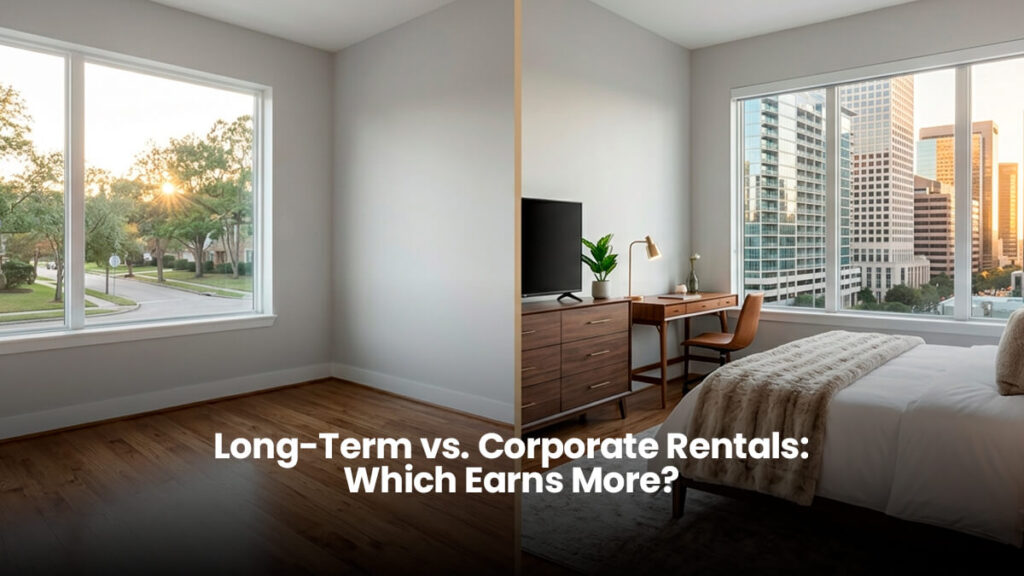
As a dedicated real estate professional here in the vibrant Houston, Texas market, one of the most frequent questions I receive from investors and homeowners alike is how to optimize their property’s income potential. The Houston rental market has shown incredible resilience and growth. According to recent data from the Houston Association of Realtors (HAR), single-family leasing activity has climbed significantly, with the average monthly lease price for single-family homes hovering firmly around $2,346.
With demand this strong, landlords are faced with a crucial strategic decision: Should you lease your property as a traditional long-term rental, or should you pivot toward the lucrative corporate housing and mid-term rental space?
Both paths offer distinct financial and operational advantages, but they cater to entirely different tenant profiles and require completely different management styles. Let us break down the mechanics of long-term versus corporate rentals in Houston so you can determine exactly which strategy will earn you more net positive cash flow.
The Bedrock of Real Estate: Long-Term Rentals
Traditional long-term rentals—typically operating on a 12-month or 24-month unfurnished lease agreement—remain the backbone of residential real estate investing for a reason. This model is built around stability, predictability, and minimal operational friction.
When I place a qualified tenant into an unfurnished long-term rental in established Houston suburbs like Katy, Cypress, Sugar Land, or even within stable Inner Loop neighborhoods, we are securing a steady baseline of income. The tenant moves in with their own furniture, sets up their own utility accounts, and takes on the daily upkeep of the property. For you as the owner, this means your monthly overhead is highly predictable, consisting primarily of your mortgage, property taxes, insurance, and a structural maintenance reserve.
The main financial drawback to long-term leasing is the ceiling on your rental price. You are bound by current local market averages reported on platforms like Realtor.com, meaning your ability to rapidly scale gross monthly revenue is limited until the lease term expires and you can adjust for inflation or market shifts. However, you benefit from a very low vacancy rate, often under 4%, and you do not have to worry about paying for electricity, high-speed internet, water, or streaming services out of your own pocket.
The Premium Play: Corporate and Mid-Term Housing
Corporate rentals, often referred to as mid-term rentals, target a completely different demographic. These are fully furnished, beautifully styled properties designed for stays lasting anywhere from 30 days to several months.
Houston is uniquely positioned to dominate the corporate housing sector. We are home to the world’s largest medical complex, the Texas Medical Center, which constantly draws thousands of traveling doctors, specialized nurses, and medical researchers who need flexible, turnkey housing. Additionally, our booming Energy Corridor, downtown financial hubs, and robust aerospace and manufacturing sectors bring in a steady stream of corporate consultants, relocating executives, and contract professionals year-round.
Because these tenants are executing corporate contracts or relying on corporate stipends, they are willing and able to pay a massive premium for convenience. A property that might rent for $2,200 a month as an unfurnished long-term home can frequently command anywhere from $3,500 to $4,800 a month as a fully equipped corporate rental.
However, this premium gross revenue comes with increased upfront capital requirements and ongoing operational expenses. To compete effectively in the Houston corporate market, you must invest heavily in high-quality furnishings, premium mattresses, dedicated workstations, ultra-fast Wi-Fi, and a fully stocked kitchen. You are also responsible for all utilities, lawn maintenance, and professional cleanings between guest stays.
The True ROI Battle: Gross Income vs. Operating Expenses
To determine which strategy earns more, we must look past gross numbers and focus entirely on your net Return on Investment (ROI).
Let us analyze a typical scenario for a modern townhome located near the Galleria or the Texas Medical Center. If you list this property as a traditional long-term rental, your gross monthly revenue is predictable, your tenants cover the utilities, and your vacancy risk is concentrated into one brief window every year or two. Your net margins remain highly stable.
If you opt for the corporate housing model, your gross monthly income sky-rockets. However, your initial startup costs will include an explicit cash outlay of $12,000 to $15,000 to professionally furnish and stage the home. Furthermore, corporate rentals experience a naturally higher vacancy rate, averaging around 8% to 10%, as you navigate the brief gaps between monthly contracts. You must also subtract the ongoing cost of landlord-paid utilities and regular property management overhead from your monthly revenue.
Even after accounting for these added operational costs, utility bills, and vacancy buffers, well-located corporate rentals in high-demand Houston corridors consistently outpace long-term rentals in net profitability. The premium paid by corporate clients is simply large enough to absorb the extra expenses and still deliver an additional $1,000 to $2,000 in net positive cash flow each month compared to a traditional lease.
Navigating Local Regulations, Taxes, and HOAs
One of the greatest advantages of the corporate rental model in Texas is how it positions you from a regulatory standpoint. Short-term vacation rentals (stays under 30 days) face immense scrutiny, strict municipal licensing rules, and aggressive pushback from neighborhood Homeowners Associations (HOAs) across Greater Houston.
Corporate rentals operate safely above the critical 30-day threshold. According to the guidelines set by the Texas Comptroller, residential stays of 30 consecutive days or longer are legally exempt from state and local hotel occupancy taxes. They are treated under general residential leasing rules rather than transient lodging laws. This means you avoid the heavy tax compliance burdens placed on short-term hosts while completely bypassing the strict short-term rental bans enforced by many local subdivisions and high-rise condo associations.
Frequently Asked Questions
What is the average length of stay for corporate tenants in Houston?
The average stay for a corporate or mid-term tenant in the Houston market ranges between 60 to 90 days. This timeline aligns perfectly with traveling nurse rotations at the Texas Medical Center, corporate relocation timelines, and temporary consulting contracts in the Energy Corridor.
Is my property a good candidate for a corporate rental?
Location and property layout are the deciding factors. If your property is a townhome, condo, or single-family home located near major employment hubs, medical centers, or popular urban areas like Midtown, Montrose, the Heights, and the Galleria, it is highly suited for corporate housing. Properties deep within strictly residential suburbs are usually better optimized for traditional long-term family rentals.
How do I find corporate tenants for my Houston property?
Corporate tenants rarely look on traditional long-term listing sites. To capture this demographic, we utilize specialized mid-term housing platforms, corporate relocation networks, insurance housing placement agencies, and direct relationships with local healthcare and energy HR departments.
How much extra wear and tear should I expect with corporate housing?
Surprisingly, corporate rentals often experience less long-term wear and tear than traditional rentals. Because professional cleanings are mandated between contracts, property managers inspect the home frequently, allowing minor maintenance issues to be caught and repaired immediately before they turn into costly problems.
Final Thoughts: Designing Your Houston Investment Strategy
If your ultimate goal is maximum passive income with zero day-to-day operational involvement, a traditional long-term rental backed by a strong property manager is an exceptional wealth-building tool. But if you own a property in a prime, asset-rich location near Houston’s major corporate or medical epicenters, transitioning to the corporate rental space is undeniably the superior path for maximizing monthly cash flow and accelerating your portfolio’s ROI.
Navigating these distinct rental markets requires an intimate understanding of neighborhood dynamics, tenant demand drivers, and localized property values. If you are looking to purchase an investment property in Houston or want to analyze whether your current asset can successfully make the jump into premium corporate housing, reach out to me today. Let us look at the numbers together and build a strategy that maximizes your real estate returns.
Aida Villalobos | Real Estate Broker
📞(346) 955-1049 / @realtor.aidavillalobos